

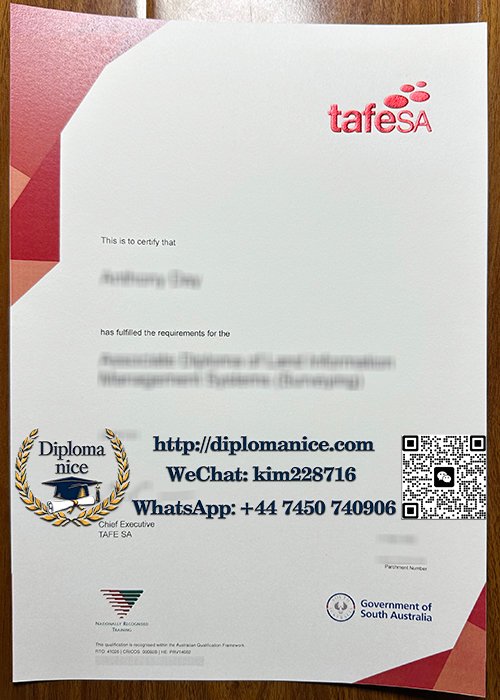
In South Australia’s (SA) vocational education and training (VET) landscape, TAFE SA (Technical and Further Education SA) is undoubtedly the most influential public institution. As the state’s largest provider of vocational training, TAFE SA’s certificates not only demonstrate skills but also bridge the gap between academic learning and practical employment. For students hoping to settle, work, or pursue further studies in South Australia, TAFE SA certificates represent government-recognized qualifications, industry-relevant skills, and a solid path to career success.
I. TAFE SA: Authoritative Endorsement of Public Education
TAFE SA is funded and regulated by the South Australian government, meaning that all its certificates carry extremely high credibility and legal recognition. Unlike private training institutions, TAFE SA’s courses strictly adhere to the Australian Qualifications Framework (AQF). The AQF is Australia’s national policy used to regulate qualification accreditation across all education sectors, ensuring that qualifications are comparable and recognized nationally and internationally.
Therefore, when you obtain a TAFE SA certificate, you gain more than just an institutional certificate of completion; you gain a nationally recognized qualification valid throughout Australia. Whether in Adelaide, Sydney, or Melbourne, employers can clearly understand the skill level and competency standards represented by this certificate. How does a tafeSA certificate look like online?
II. Certificate System: A Ladder from Beginner to Expert
TAFE SA offers a complete curriculum ladder from basic skills to higher education, covering almost all industry sectors including architecture, engineering, business, nursing, information technology, and creative arts. Its certificate system is mainly divided into the following levels:
1. Certificates I & II
This is the introductory stage of vocational education, focusing primarily on developing basic skills and career preparation.
Target Audience: High school students, individuals wishing to return to the workforce, or students needing to improve their basic English and mathematics skills.
Content: Provides basic job skills for specific industries, such as entry-level hospitality, basic construction skills, or workplace communication skills. The surprising methods to obtain a tafeSA certificate online?
2. Certificate III
This is the backbone of Australian vocational education and is generally considered the standard threshold for becoming a qualified tradesperson.
Core Value: In industries such as construction, electrical work, plumbing, automotive repair, and hairdressing, Certificate III is a necessary condition for obtaining a license or practicing independently.
Study Duration: Typically combines classroom learning with mandatory internships to ensure students are ready to work immediately upon graduation.
3. Certificate IV
This level marks the transition from “operator” to “supervisor” or “expert.”
Career Advancement: In addition to deepening professional skills, it adds content on management, leadership, and complex problem-solving. For example, in the construction industry, Certificate IV is often a prerequisite for applying for a “Supervisor Licence.”
Specialization: Suitable for professionals who wish to develop in-depth expertise in specific areas (such as cybersecurity, accounting, project assistant).
4. Diplomas & Advanced Diplomas
This is the high-level vocational education, focusing on advanced skills, technical management, and professional knowledge.
Employment Orientation: Graduates typically find employment as junior managers, senior technicians, or professional consultants.
University Stepping Stone: This is a highly attractive aspect of the TAFE SA certificate system – many TAFE SA diploma courses are linked to university degrees.
III. Unique University Pathways: A “Direct Line” from TAFE to University
A core advantage of TAFE SA certificates lies in their flexible credit transfer policy. Several universities in South Australia (such as the University of South Australia, the University of Adelaide, and Flinders University) have established close partnerships with TAFE SA.
This means that if you complete a TAFE SA diploma or advanced diploma course, you can usually apply directly to a related university’s undergraduate degree program, receiving credit transfers ranging from six months to one year. This “TAFE + University” model offers an excellent alternative path for students whose Gaokao (National College Entrance Examination) scores are not ideal, or who wish to obtain a bachelor’s degree in a more cost-effective and practical way. It not only saves on expensive university tuition fees but also allows students to accumulate rich practical experience before entering university.
IV. Industry Relevance: Designed for Employment
TAFE SA’s curriculum is not developed in isolation but is designed with direct involvement from industry experts.
Hands-on Focus: The curriculum emphasizes “learning by doing” and boasts modern training facilities (such as simulated hospital wards, construction sites, and commercial kitchens).
Mandatory Workplace: The vast majority of certificate courses include mandatory industry placements, allowing students to gain real-world work experience and build professional networks before graduation.
Faculty Background: Instructors are typically seasoned industry professionals with many years of frontline experience, rather than purely academic researchers.