

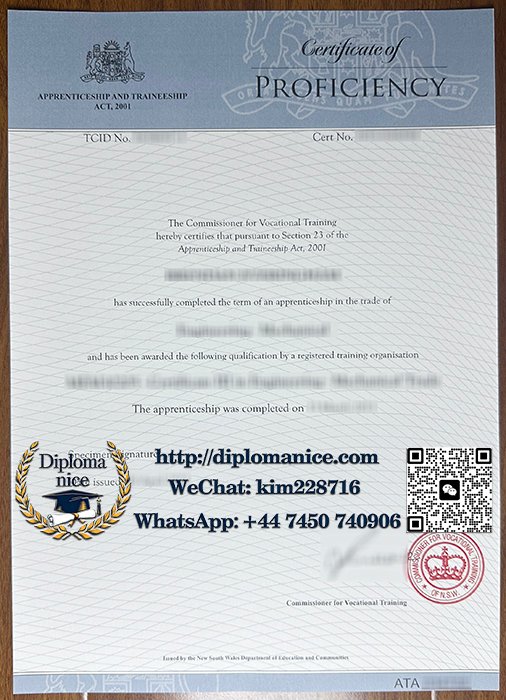
In the large and highly regulated construction industry of New South Wales (NSW), Australia, one certificate is considered a watershed moment in a professional’s career—the Certificate of Proficiency (CoP). For any professional hoping to work in a specific construction field, sign compliant documents, or even run a construction business in NSW, the CoP is more than just a piece of paper; it is authoritative proof of their technical competence, legal compliance, and professional reputation.
I. What is the NSW Certificate of Proficiency (CoP)?
The Certificate of Proficiency is a statutory qualification issued by NSW Fair Trading. It primarily serves to demonstrate that the holder possesses the necessary skills and knowledge to work in a specific construction field, complying with the Home Building Act 1989 and related regulations.
While the “Contractor Licence” issued by NSW Fair Trading is more widely known, the CoP plays an indispensable role in certain situations. It is generally considered a “proof of competence,” allowing the holder to perform specific work without a full contractor license, or as a prerequisite for applying for a higher-level license. Why i want to get a NSW Certificate of Proficiency diploma online?
II. Core Categories and Application Scenarios of CoP
CoP is not a single certificate, but a certification system covering multiple professional fields. Depending on the nature of the work, it is mainly divided into the following categories:
1. Supervisor Certificate
This is the most common type of CoP. In NSW, anyone applying for a Qualified Supervisor Certificate (QSC) or an individual contractor license must demonstrate that they possess the relevant supervisory competence.
Function: It proves that the certificate holder not only understands the technology but also knows how to manage a construction site, ensure compliance, and manage health and safety (WHS).
Target Audience: Senior technicians preparing to advance to site manager, project manager, or independent contractor.
2. Certificate of Proficiency for Limited Work
Not all construction work requires a full license. For certain specific, low-risk, or highly specialized jobs, NSW Fair Trading allows CoP holders to perform these tasks. Waterproofing: This is the most typical example. In New South Wales, a CoP or license is required to perform residential waterproofing work.
Post-tensioned steel reinforcement: Steel reinforcement work involving the safety of specific structures.
Suitable for: Experts specializing in a particular sub-field who may not need to undertake the entire building project but must legally perform that specific work.
3. Certificate of Completion: In some cases, a CoP also refers to proof of completion of a specific training course (such as certain advanced diploma courses at TAFE NSW), which is one of the necessary documents for applying for a license. How fast does to obtain a NSW Certificate of Proficiency diploma?
III. The Rigorous Path to Obtaining a CoP: A Dual Test of Experience and Theory
Obtaining an NSW Proficiency Certificate is no easy feat; it requires applicants to meet the state government’s stringent standards in both “practical experience” and “theoretical knowledge.”
1. Industry Experience: This is the cornerstone of the application. Applicants typically need to provide detailed evidence demonstrating at least two years of full-time (or equivalent part-time) work experience in the relevant field.
Evidence Required: This goes beyond just employer recommendations. Typically, it also requires tax records (Notice of Assessment), payslips, and even specific project contracts and invoices to verify the authenticity and duration of the experience.
2. Technical Training: In addition to experience, applicants must complete technical training accredited by NSW Fair Trading. This usually includes:
TAFE courses: such as advanced diplomas related to building and construction.
Short courses: certification courses focusing on specific skills (such as waterproofing, reading blueprints).
3. Competency Assessment: For certain categories of CoP, applicants may need to demonstrate their ability to solve practical problems through an interview or written assessment, particularly regarding the application of the Building Code of Australia (BCA) and Australian Standards.
IV. The Professional Value of a CoP: Why is it a “Mandatory” Requirement?
In the highly competitive New South Wales construction market, holding a CoP (Copyright Certificate) has significant strategic value:
1. A Legal Compliance Safeguard: In NSW, working in regulated construction without a license or permit is illegal and carries hefty fines. A CoP ensures the legality of practitioners performing certain high-skilled tasks (such as waterproofing), mitigating legal risks.
2. A Stepping Stone to Management: For skilled workers looking to transition from “doers” to “managers,” the Supervisor CoP is essential. It’s a prerequisite for obtaining an Individual Contractor Licence. Without this certificate, you cannot legally undertake construction projects exceeding $5,000 AUD (including labor and materials) in your own name.
3. A Market Advantage: Presenting a CoP certificate directly demonstrates your professional competence to employers or general contractors when applying for jobs or subcontracting projects. Especially in specialized fields like waterproofing and structural repair, a CoP is often a prerequisite for being shortlisted as a supplier.